
Systemic Resilience
The Solution to the Risk Gap
Moving from component monitoring to end-to-end assurance. AI-FPM combines a 7-step process with a bespoke toolset to deliver quantified risk clarity.
The 7-Step AI-FPM Approach
From Ingestion to Executive Decision
Mapping
Maps AI-enabled decision pipelines end-to-end, from raw data ingestion to the final decision, establishing critical context and boundaries.
Modelling & Discovery
Identifies and models plausible failure modes, finding hidden fragilities to answer the critical question: 'How could this break silently?'
Impact Assessment
Traces cascading and compounding impacts across the system to understand the true business effect of isolated errors.
Containment
Designs monitoring, targeted controls and circuit breakers to halt failure chains before they impact the customer or business operations.
Mitigation
Compiles the remediation action plan, allocating resources to remove high-priority risk vectors identified in the model.
Testing
Stress-tests detection and response assumptions through rigorous tabletop exercises to ensure controls effectively catch modelled failures.
Recovery
Documents recovery and reinstatement playbooks with clear protocols for restoring services after a failure, ensuring operational continuity.
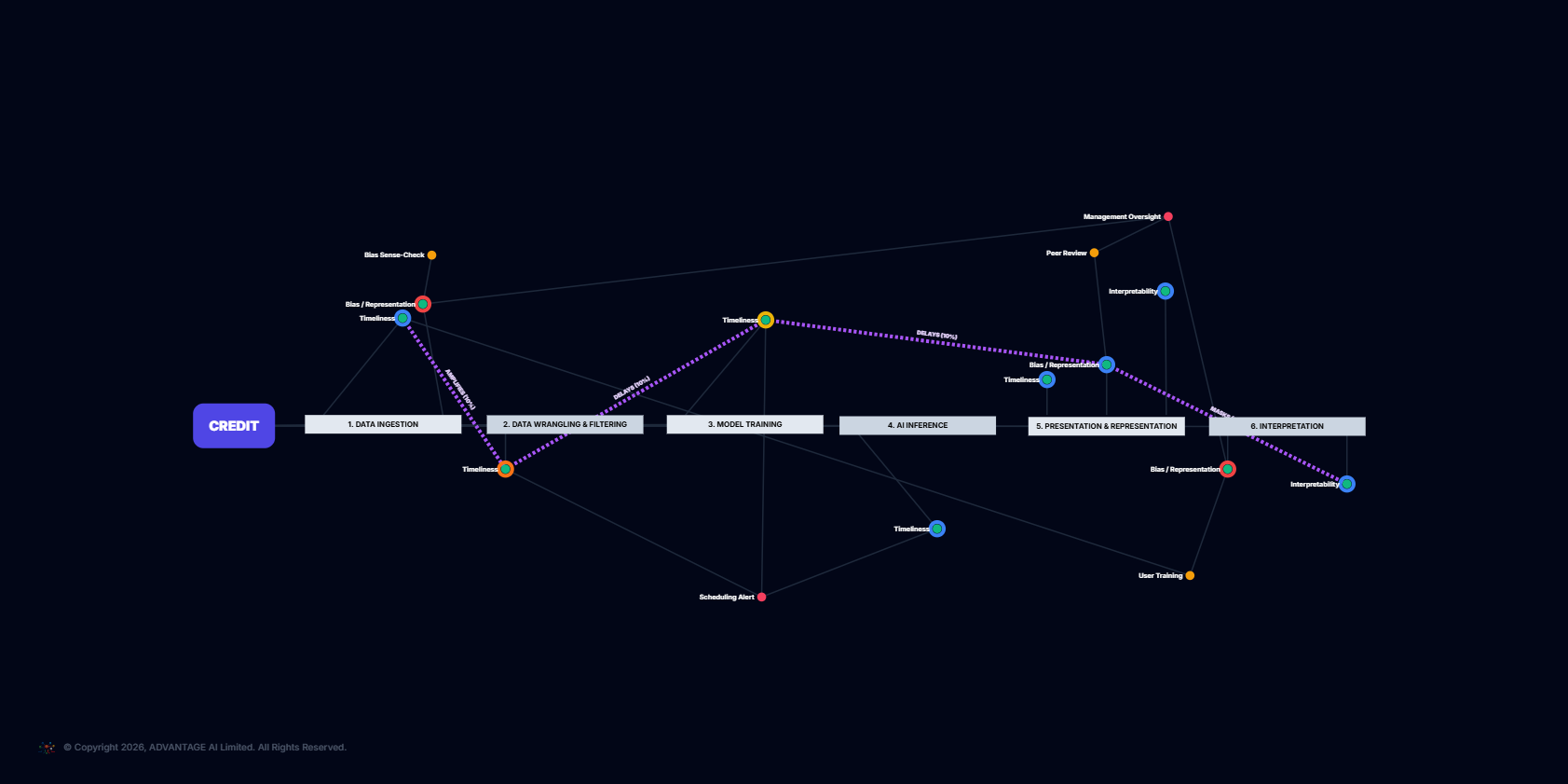
Advanced Toolset Support
We don't just use whiteboards, sticky notes and spreadsheets. Our unique AI-FPM toolset automatically generates your key outputs such as Risk Heatmaps and Remediation Plans that can be exported directly into your internal GRC systems.
Compliance Alignment
Algorithmic Accountability
The AI-FPM methodology is aligned with leading global standards and UK-specific mandates — meeting the increasing expectations for algorithmic accountability.
While frameworks like NIST AI RMF and ISO 42001 provide the "what" of AI governance, AI-FPM provides the "how" for specific, high-stakes use cases. Our process operationalises the MAP and MEASURE functions of NIST by turning complex technical interdependencies into a visual blueprint of risk.
For regulated finance companies, the methodology serves as a critical tool for satisfying the PRA’s SS1/23 Principle 3, requiring firms to identify and remediate model limitations and systemic weaknesses. It also provides the "end-to-end transparency" necessary for Consumer Duty compliance proving that AI-driven decisions are not resulting in foreseeable harm or biased outcomes for customers.
Crucially, it also addresses the requirements of the EU AI Act for high-risk systems, specifically regarding risk management systems (Art. 9) and human oversight (Art. 14).
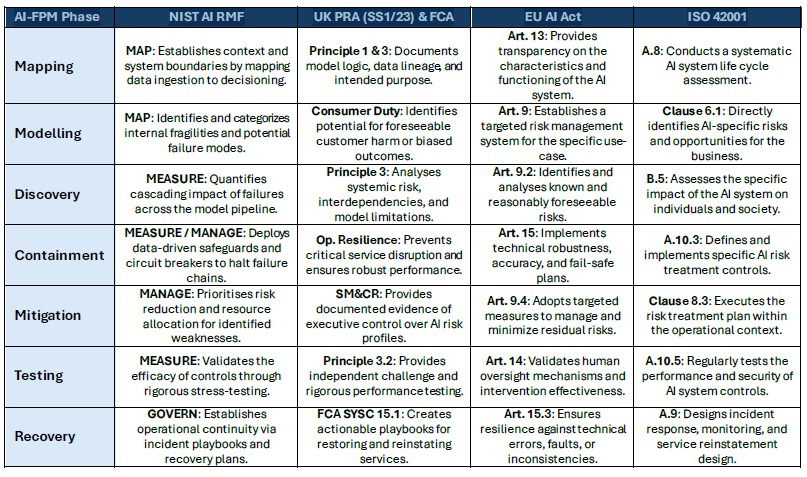
Compliance Matrix Image Placeholder
Resilience Delivered at Pace
Whilst full AI Assurance assessments take 6-8 weeks, our AI-FPM facilitated workshops deliver a detailed risk assessment and actionable remediation plan within days.